Obsessive-compulsive disorder is often simplified in everyday language with the expression “being obsessive.” However, OCD is not merely liking order, being sensitive about cleanliness, or attaching too much importance to certain matters. From a clinical perspective, OCD is a cycle formed by unwanted, distressing, and repetitive thoughts that enter a person’s mind, and by behaviors or mental rituals performed to reduce the anxiety created by these thoughts. Over time, this cycle can significantly affect a person’s daily life, relationships, school or work routine, and inner peace. NIMH defines OCD as a long-term mental health condition that involves difficult-to-control, repetitive thoughts and/or repetitive behaviors, and that can impair a person’s quality of life.
One of the most difficult aspects of OCD is that it is often not understood from the outside. When a person checks the door again and again, those around them may see it as simple worry. Someone who washes their hands repeatedly may be thought of only as meticulous. A person who constantly seeks reassurance because of disturbing thoughts passing through their mind may be accused of being “too sensitive.” However, in OCD, the issue is not the behavior itself as much as the compulsive inner tension behind the behavior. The person often knows that what they are doing is irrational or exaggerated; yet knowing this may not be enough to stop the behavior. Because OCD is not an anxiety that can be silenced with logic in a single move, but a system that continuously feeds itself between anxiety and relief.
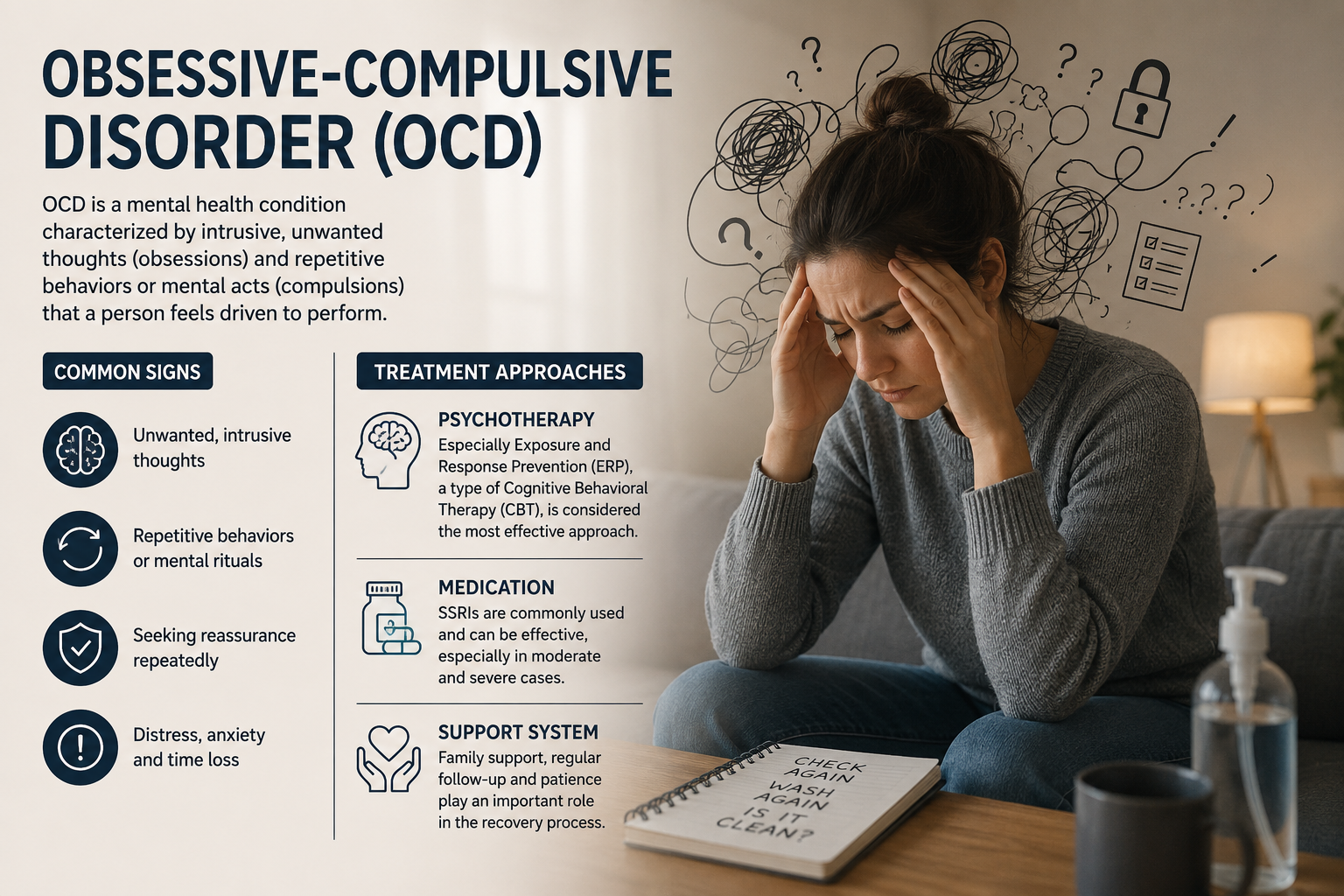
At the center of this system are obsessions and compulsions. An obsession is an unwanted, disturbing, and repetitive thought, image, or impulse that enters the person’s mind. These may appear as fear of contamination, concern about harming someone, fear of making a mistake, disturbing thoughts with religious or moral content, a need for symmetry, or intense doubt that something may have been left incomplete. A compulsion is the behavior or mental act performed to reduce this distress. Repeated washing, checking, counting, arranging, repeating certain words internally, praying, constantly trying to be sure, or seeking reassurance from others can be examples of compulsions. NIMH states that in OCD, obsessions are unwanted and anxiety-provoking thoughts, while compulsions are often repetitive behaviors performed in response to these obsessions.
The main point that distinguishes OCD from ordinary habits is that the person cannot establish sufficient control over these thoughts and behaviors, and that they become a clear burden in life. Every person checks the door from time to time, cares about cleanliness, or wants to be sure of something they have done. However, in OCD, repetitive thoughts and behaviors often take up the person’s time, exhaust the mind, and impair daily functioning. According to NIMH, in OCD, even if the person sees their obsessions or compulsions as excessive, they may have difficulty controlling them; these symptoms may take more than one hour a day and lead to serious problems in daily life.
The feeling of “relief” has an important place in understanding this disorder. A person experiencing OCD often feels short-term relief when they perform the compulsion. They check the door and feel relieved for a moment. They wash their hands and the fear of contamination decreases temporarily. They receive the answer “No, you did not do anything bad” from someone, and their mind becomes quiet for a while. But this relief is not permanent. After some time, the mind produces the same question again. “What if I did not check enough?”, “What if it is still dirty?”, “What if I really did something bad?” For this reason, although compulsion may appear at first glance to be solving the problem, in the long term it can strengthen the OCD cycle.
It would not be correct to speak of a single cause in the emergence of OCD. Genetic predisposition, the way brain circuits function, learned behavioral patterns, stressful life events, and the person’s way of tolerating uncertainty may all contribute to this picture. In some people, symptoms begin in childhood or adolescence, while in others they become more visible in adulthood. The intensity of symptoms may change from time to time. Stress, fatigue, major life changes, or traumatic experiences can increase OCD symptoms. However, the point that must be noted here is this: OCD is not a weakness of character, a lack of faith, or a lack of willpower. This is not something a person can easily get out of simply by saying to themselves, “I am exaggerating, so I should stop.”
In the treatment process, the most important approach is not to try to solve OCD only by discussing the thoughts. Because OCD is often fed by the search for certainty. As the person tries to find a definite answer to the thought in their mind, the mind produces a new doubt. Therefore, the aim in treatment is not so much to refute every thought one by one, but to help the person build a healthier relationship with uncertainty and reduce their dependence on compulsions.
One of the most commonly used scientific approaches in OCD treatment is cognitive behavioral therapy. One of the most effective forms of this therapy used specifically for OCD is exposure and response prevention. This method aims for the person to encounter anxiety-provoking situations in a controlled way and with the guidance of a therapist, while learning not to perform the usual compulsive behavior in response. The International OCD Foundation states that ERP is based on facing the thoughts, objects, or situations that trigger a person’s obsessions and preventing the compulsive response. NHS also explains that the therapy used in OCD treatment is mostly cognitive behavioral therapy that includes exposure and response prevention.
This process may feel difficult to the person at first. Because OCD treatment requires the person not to immediately escape from the thing they fear or perform rituals to calm themselves, but to allow the anxiety to exist for a while. However, the aim of therapy is not to throw the person into their fears unprepared. A healthy treatment process progresses gradually, in a planned and safe manner. The person first works with more manageable situations; over time, they begin to experience that anxiety can decrease on its own even if it rises, that the feared disaster does not occur when the compulsion is not performed, and that the mind does not have to answer every doubt.
Medication treatment can also have an important place in OCD. Especially in cases where symptoms are intense, daily life is significantly affected, or intense anxiety and depressive symptoms accompany the therapy process, psychiatric evaluation is necessary. Mayo Clinic states that the main approaches in OCD treatment are psychotherapy and medication, and that in some cases the combined use of these two methods may be more effective. NICE guidelines also state that in adults whose functioning is seriously affected, CBT/ERP treatment together with SSRI group medications may be considered.
Medication use in OCD must always be under the supervision of a physician. It is not appropriate for a person to start medication on their own, change the dose, or stop the medication suddenly. NIMH states that antidepressants used in OCD treatment may take weeks to show their effect and that medications should be arranged under the supervision of a healthcare professional. For this reason, it is important for the person who begins treatment to be patient, to follow the process regularly, and to share any side effects or concerns with their specialist.
The attitude of families and close circles is also decisive in OCD treatment. Loved ones often try to comfort the person with good intentions. Sentences such as “Nothing happened,” “You are clean,” “The door is closed,” or “You are not a bad person” may calm the person in the short term. However, constant reassurance can in some cases become a part of the OCD cycle. Therefore, the goal of close circles should be to support the treatment process, not to judge the person. Saying to someone with OCD, “Do not do this, you are being ridiculous,” generally does not work; instead, an approach that acknowledges the distress they experience as real but does not feed the compulsions is healthier.
One of the most sensitive points in struggling with OCD is the feeling of shame. Especially people who experience obsessions with religious, sexual, aggressive, or moral content may think that these thoughts reflect their true desires. However, an important part of obsessions are thoughts that the person does not want, that disturb them, and that feel foreign to them. The fact that the person is disturbed by these thoughts often shows that they conflict with their own values. For this reason, in OCD, what matters is not so much the content of the thought, but the relationship the person establishes with that thought. The treatment process aims precisely to change this relationship.
OCD is not a condition that can be solved by completely ignoring it or by simply saying “do not think about it.” At the same time, with the right treatment, it is possible to manage the symptoms, significantly improve quality of life, and allow the person to continue daily life more freely. NIMH emphasizes that rather than using a definite expression of “complete cure” for OCD, existing treatments may help people manage their symptoms and improve their quality of life.
The most accurate way to understand OCD is to see it not as a habit of “overthinking,” but as a serious psychological cycle shaped around anxiety, uncertainty, and the search for relief. The earlier this cycle is recognized and appropriate support is received, the healthier the person’s relationship with themselves can become. For someone experiencing OCD, recovery does not mean completely silencing every thought that passes through the mind. A more realistic goal is not allowing the thoughts that come to mind to control life, being able to stand more resiliently in the face of anxiety, and slowly stepping out of the narrow space determined by compulsions.
This article is for informational purposes only. If OCD symptoms affect a person’s daily life, relationships, school or work routine, professional support should be sought from a psychiatrist, clinical psychologist, or mental health professional.