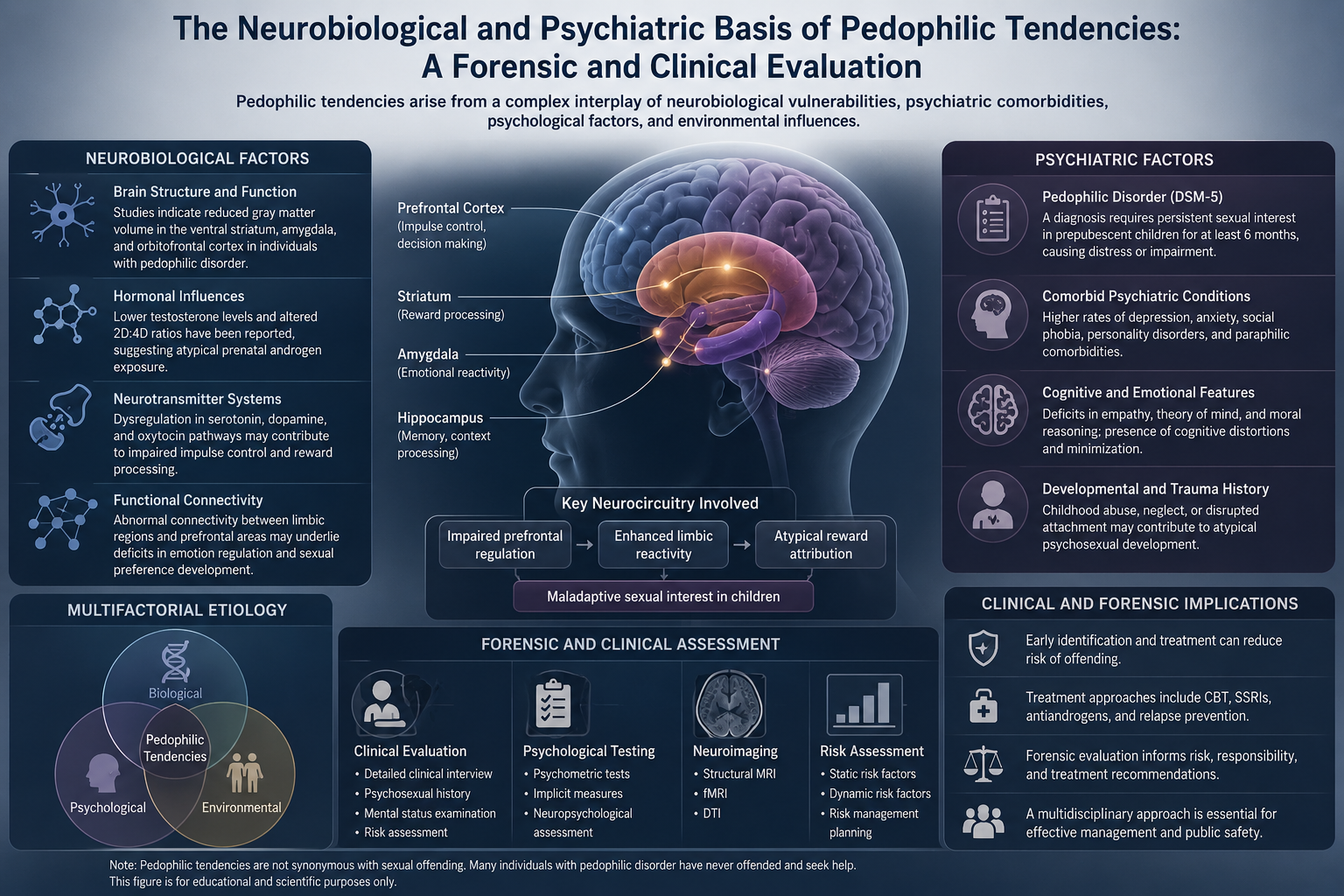
The Neurobiological and Psychiatric Foundations of Pedophilic Tendencies: A Forensic and Clinical Evaluation
Pedophilia cases, which directly threaten public safety and child development, not only constitute a severe criminal element before judicial authorities but are also addressed as a complex neuropsychiatric clinical picture. When the current forensic psychology and neurology literature is examined, non-standard structural differences have been identified in the brain anatomies and neural networks of individuals with this tendency. This text has been prepared to examine the neurobiological origins of this psychiatric deviation and its importance in terms of regional health policies within a structural framework.
Structural and Functional Deviations in Brain Anatomy
Radiological examinations (especially fMRI and PET scans) conducted on cases referred to clinical psychiatric boards reveal significant anomalies in the brain structures of pedophilic individuals.
The most striking physiological finding is a statistical decrease in the volume of white matter, which provides the connection between the right and left hemispheres of the brain. This structural deficiency reduces the speed of signal transmission between neurons, thereby preventing the cognitive filtering of sexual impulses. Furthermore, volumetric asymmetries are observed in the amygdala, the epicenter of threat perception and emotional responses, and the hypothalamus, the regulator of hormonal balance. This neurological deformation paves the way for the failure of the individual's normal mechanism of sexual attraction toward adults to develop, directing it instead toward individuals whose development is incomplete.
Prefrontal Cortex Dysfunction and the Impulse Control Mechanism
Functions such as decision-making, conforming to social rules, and suppressing impulses are carried out by the prefrontal cortex, the frontal lobe of the brain. When criminal profiles recorded in forensic medicine registries are subjected to neuro-cognitive tests, a severe weakness in the prefrontal cortex activities of these individuals is reported.
This loss of function disrupts the individual's ability to reason the legal and moral consequences of their actions. A lack of empathy (specifically, a lack of cognitive empathy intersecting with psychopathy) is directly associated with insufficient blood flow in this region. This neurological infrastructure proves that the act is not a momentary "loss of control"; on the contrary, it is a systematic reflection of a faultily coded reward-punishment mechanism.
Regional Risk Analysis and Preventive Health Strategies
Addressing the issue in coordination with local health directorates and forensic medicine units across Turkey is of critical importance for identifying regional risk factors. In light of data suggesting that pedophilic tendencies may be linked to severe head trauma or developmental neurological disorders in early childhood, screening mechanisms to be structured at the local level will serve as a vital filter.
It is particularly necessary for health institutions operating in rural and socio-economically disadvantaged areas, far from metropolitan cities, to be able to detect cases exhibiting atypical impulse control disorders at an early stage. Regional forensic psychiatry maps, to be created using geographic information systems (GIS), have the potential to directly guide the fieldwork of law enforcement and social workers.
Transitioning the psychiatric evaluation process from a reactive system that only comes into play after a crime has occurred, to a proactive model where neuro-cognitive tests are integrated down to the level of local health clinics, is a necessity dictated by current data. These findings must be processed in the joint databases of forensic and medical authorities and evaluated as a primary reference source in the reshaping of public health policies.